FuturePositive
    About the Atlas

    Change management models, mapped in one Atlas.

    Decision-grade intelligence for organisations designing and monitoring transformation: adaptive, interactive and continuously updated.

    Open the Atlas
    The Future Positive Atlas: the transformation landscape on a map
    01 · What it is

    More than a dashboard. An adaptive intelligence platform.

    Unlike static dashboards, the Atlas holds together three forms of evidence rarely found on one surface: quantitative depth, qualitative reach and the world’s standards, each read against the others.

    135+Quantitative depth

    Years of organisational data, indexed across 190+ countries and 100+ indicators.

    12k+Qualitative reach

    Indexed pages and 4,500+ deep-dive publications, read in their primary sources.

    3Disciplines

    Hard science (Google, IBM), legal compliance (EU AI Act, NIST), human psychology (Prosci, Kotter).

    12+Source standards

    The Global Intelligence Matrix: every major framework, read against the others.

    Sources includeBCG AI at ScaleMIT CISREU AI ActProsci ADKAR®IBM AI EthicsKPMG Trusted AIDeloitteGoogle CloudKotter 8-StepsNIST AI RMF
    02 · How to read it

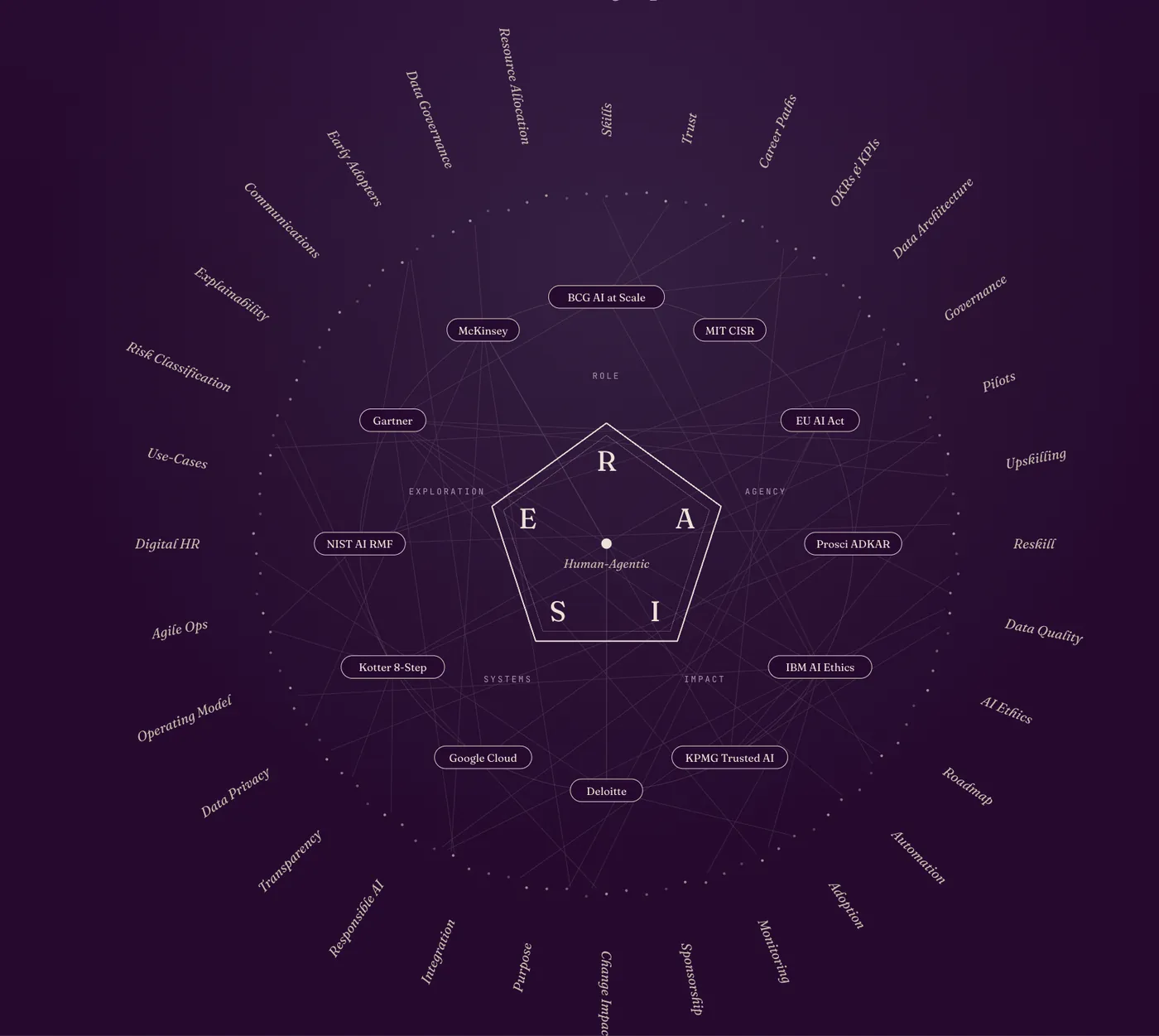
    Three rings. One question per node.

    Each ring of the map answers a different question. The deeper you travel, the more specific the answer becomes.

    Centre · The Pentagon

    What dimension are we operating in?

    Five forces every transformation must hold open: Role, Agency, Impact, Systems, Exploration.

    Five dimensions

    Middle · The Frameworks

    Which school speaks to it?

    Twelve global syntheses: eighty years of postwar organisational science, read against one another.

    Twelve frameworks
    Outer · The Levers

    What is the specific move?

    One hundred and eleven transformation levers: the actual material of the work.

    111 levers
    “By synthesising twelve global standards into the five Future Positive Principles, we make the human element measurable, predictable and actionable.”
    Ina Catrinescu · Founder, Future Positive
    03 · Core functions

    From intelligence to action.

    The Atlas bridges the gap between data-heavy frameworks and people-first outcomes. It applies two lenses across every diagnostic.

    The howThe five Future Positive Principles

    Self-Directed, Agency-Centred, Impact-Led, System-Focused, Evolution-Driven: the human measures beneath every score.

    The operationalisationThe RAISE Framework

    Role, Agency, Impact, Systems, Exploration: the five forces that turn principle into a sequence of moves.

    01

    Diagnostic intelligence and legitimacy scanning

    Deep-tissue diagnostics that expose adaptability gaps and systemic fragility. The Global Intelligence Matrix turns fragmented inputs into decision-grade intelligence, making people-first principles measurable and visible.

    02

    Predictive trend and risk analysis

    A longitudinal dataset spanning 135 years and 190+ countries powers trend analysis, letting organisations anticipate socio-technical challenges and adapt before crises escalate.

    03

    Evidence-based foresight

    The Atlas translates complex evidence into clear strategic options aligned with the RAISE model, so every decision is grounded in research and anchored in legitimacy.

    04

    Democratised transformation intelligence

    The Atlas removes the expert barrier. Anyone driving transformation can act on timely insight, keeping even the most complex change anchored in both human psychology and hard science.

    04 · How levers are scored

    Every lever, read against five principles.

    Every lever in the Atlas is assessed against the five Future Positive Principles: Self-Directed, Agency-Centred, Impact-Led, System-Focused and Evolution-Driven.

    Each principle is scored from 0 to 1. A score of 0 means no alignment; a score of 1 means the lever is aligned. The adaptability average combines the five scores into one figure. It shows how much a lever builds an organisation’s capacity to keep adapting.

    05 · Publication and citation

    A versioned, citable publication.

    Cite a lever

    Catrinescu, I. (2026). {Lever Name}. In Future Positive Atlas (Edition 2026, v1.0). Future Positive.

    The twelve frameworks

    Change and AI frameworks, step by step.

    Kotter 8-Step

    8 steps
    1. Create a Sense of UrgencyMake the case that acting now matters.Urgency
    2. Build a Guiding CoalitionAssemble the sponsoring leadership group.Sponsorship
    3. Form a Strategic VisionDefine and communicate the change story.Strategic Vision
    4. Enlist a Volunteer ArmyGalvanise a committed critical mass.Early Adopters
    5. Enable Action by Removing BarriersClear the structures that block movement.Removing Barriers
    6. Generate Short-Term WinsBank visible early proof.Short-Term Wins
    7. Sustain AccelerationConvert each win into the next push.Momentum
    8. Institute ChangeAnchor new behaviours until they stick.Making It Stick

    Prosci ADKAR®

    5 steps
    1. AwarenessWhy the change is needed.Business Case · Awareness
    2. DesirePersonal motivation to support the change.Motivation
    3. KnowledgeSkills and information to change.Skills
    4. AbilityImplementing new behaviours in practice.Ability
    5. ReinforcementSustaining the change over time.Making It Stick

    Deloitte Human-Centred Change

    5 steps
    1. Tell a compelling storyPurpose-led narrative for the change.Purpose · Communications
    2. Build transformation leadershipAuthentic leaders who carry the change.Transformation Leadership
    3. Galvanize a committed 25 percentCritical mass of early adopters.Early Adopters
    4. Redesign work and reskill workersRole change and learning moving together.Redesign & Reskill
    5. Harness the power of GenAI and dataGenAI and data as change accelerants.GenAI

    McKinsey Rewired

    6 steps
    1. Business-led digital roadmapStrategy concentrated on value domains.Roadmap · Sequenced Investments
    2. Digital talentThe in-house talent bench.Career Paths · Digital HR
    3. Operating modelCross-functional pods over silos.Operating Model · Agile Ops
    4. TechnologyDistributed, modular technology environment.Distributed Technology
    5. DataData as reusable products.Data Architecture · Embedded Data
    6. Adoption and scalingChange management matching tech investment.Assets · Capability-Building

    BCG AI at Scale

    4 steps
    1. Algorithms (10%)The model layer — a tenth of the effort.Resource Allocation · Scaling AI
    2. Technology and data (20%)Platforms, pipelines and data foundations.Data Strategy · Modular Architecture
    3. People and processes (70%)Where most of the transformation effort lives.Upskilling · Culture & Change
    4. Deploy–Reshape–InventBCG’s three value plays for AI.Deploy–Reshape–Invent

    Google Cloud AI Adoption Framework

    6 steps
    1. LearnUpskilling the workforce on AI.Upskilling
    2. LeadExecutive sponsorship and mandate.Sponsorship
    3. AccessData management, sharing and discoverability.Data Management · Data Sharing
    4. ScaleManaged services and platform scalability.Managed Services · Modular Architecture
    5. SecureProtecting AI systems and data.Security
    6. AutomateAutomated ML pipelines end to end.MLOps

    MIT CISR AI framework

    4 steps
    1. Experiment and PrepareEarly exploration and foundations.Experimentation
    2. Build Pilots and CapabilitiesStructured pilots growing real capability.Pilots
    3. Develop AI Ways of WorkingAI woven into daily operations.Automation
    4. Become AI Future ReadyThe scalable, AI-native enterprise.Scalable Enterprise

    Gartner IT Score for AI

    7 steps
    1. StrategyA strategic compass tied to enterprise goals.AI Strategy
    2. Value — AI Product PortfolioUse-cases tested against business impact.Use-Cases · Business Impact
    3. GovernanceRisk management and decision rights.Risk & Compliance
    4. EngineeringThe technical delivery pillar.AI Engineering
    5. DataQuality, governance and readiness.Data Quality
    6. Operating ModelHow the organisation structures AI delivery.Operating Model
    7. People and CultureSkills breadth and cultural readiness.People & Culture

    Boomi Process Maturity Ladder

    5 steps
    1. Manual ProcessesWork performed and logged by hand.Manual Process Logs
    2. Automated ProcessesDigitised tasks at scalable efficiency.Workflows
    3. Intelligent ProcessesAI augmenting human judgement at decision points.Human-Machine Intelligence
    4. Optimized ProcessesContinuous data-driven refinement in production.MLOps
    5. Disruptive ProcessesAI-native operations unlocking new business models.Hyperautomation

    IBM AI Ethics

    5 steps
    1. ExplainabilityTransparent AI decision-making.Explainability
    2. FairnessBias reduction in AI solutions.Fairness
    3. RobustnessSecure, reliable systems under stress.Robustness
    4. TransparencyResponsible disclosure across the lifecycle.Transparency
    5. PrivacyData rights and consent protection.Data Privacy

    KPMG Trusted AI

    10 steps
    1. FairnessFairness
    2. TransparencyTransparency
    3. ExplainabilityExplainability
    4. AccountabilityAccountability Embedded
    5. Data integrityData Integrity
    6. ReliabilityReliability
    7. SecuritySecurity
    8. SafetySafety
    9. PrivacyData Privacy
    10. SustainabilitySustainability

    EU AI Act

    4 steps
    1. Unacceptable riskProhibited AI practices.Prohibited AI
    2. High riskStrict obligations: classification, conformity, documentation.Risk Classification · Conformity Assessment
    3. Transparency riskDisclosure duties for limited-risk systems.Transparency
    4. Minimal or no riskUnregulated tier — no specific obligations.
    All 111 levers

    Every lever, A to Z.

    Sources and references

    The twelve, cited at source.

    The Atlas is an original synthesis. Each framework it speaks to is referenced nominatively and cited at its primary source. We restate every framework in our own words and reproduce no proprietary text or diagrams.

    References to third-party frameworks are nominative. Future Positive is not affiliated with or endorsed by McKinsey & Company, Prosci, BCG, Deloitte, KPMG, IBM, Google, Gartner, Boomi, MIT or any other referenced organisation. All trademarks are the property of their respective owners.

    06 · The road ahead

    Atlas 2.0.

    Future Positive is building the Atlas toward a fully integrated, generative capability for designing and monitoring the world’s most complex transformations.

    In development · I

    Intelligent mediation and workflow

    Custom workflows for employees and leaders, embedded in the way work actually happens, not laid over the top of it.

    In development · II

    AI-powered co-pilot

    A bespoke co-pilot that guides leaders through multi-year strategies anchored in the five Future Positive Principles, with real-time course corrections.

    In development · III

    Dynamic scenario and review suite

    Live indicators for short-, medium- and long-term planning. Review Mode runs structured periodic reviews against the five Future Positive Principles.

    Ready to read the map?

    Open the Atlas →